
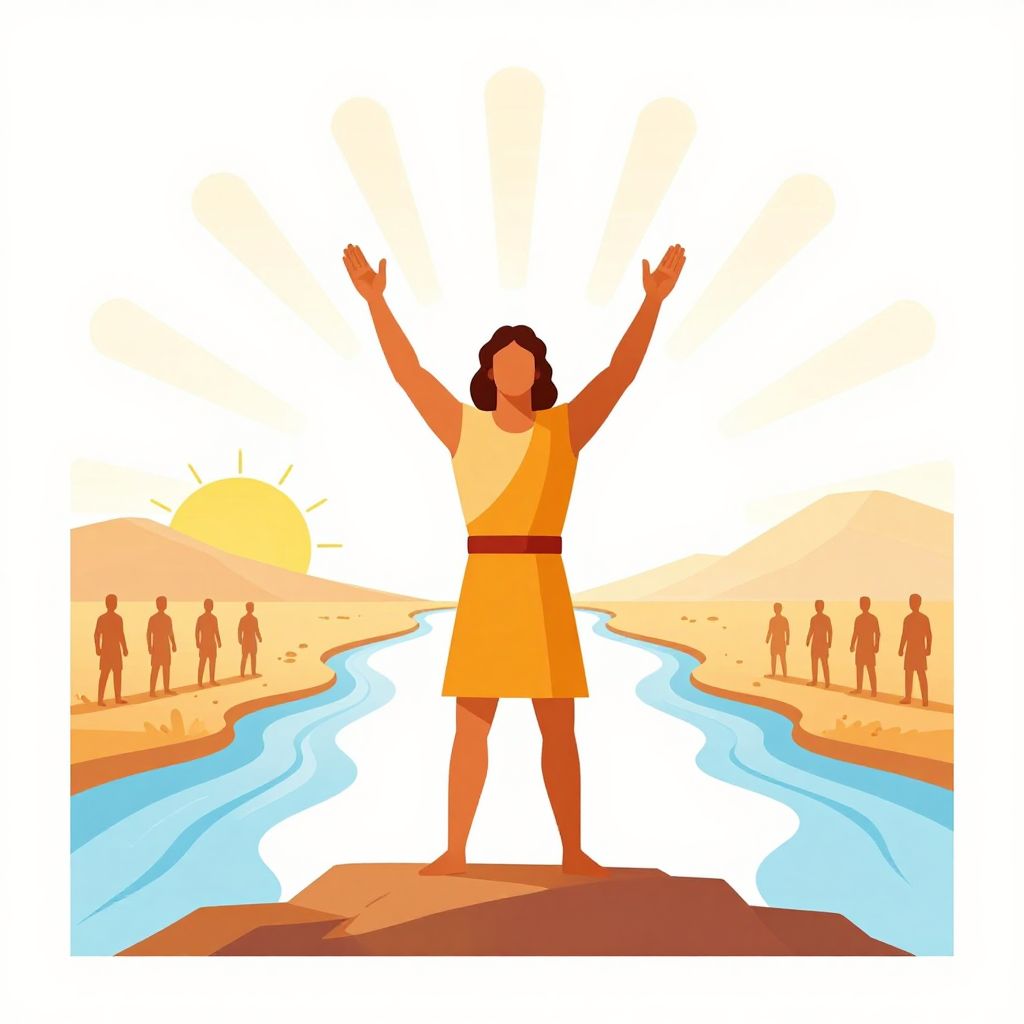
Joshua stands as one of the most faithful and courageous leaders in all of Scripture. He took an entire generation of Israelites who had wandered in the wilderness and led them into the land God had promised their forefathers.
His story offers profound lessons about faith, obedience, and what it looks like to trust God when the odds seem impossible. Let’s explore what Joshua actually did and why his life still speaks to believers today.
What Did Joshua Do in the Bible?
Joshua served as Moses’ assistant, led Israel into the Promised Land, conquered Canaan through faith and obedience to God, divided the land among the twelve tribes, and called Israel to covenant faithfulness before his death. He transformed a wandering nation into a settled people who possessed what God had promised.
Joshua’s Early Role as Moses’ Assistant
Before Joshua became a leader, he learned to serve. He assisted Moses faithfully for decades, watching how God worked through his mentor.
Joshua first appears in Exodus 17 when Moses chose him to lead Israel’s army against the Amalekites. He won that battle not through his own strength but because Moses held up his hands in intercession.
This pattern defined Joshua’s entire life. Victory came through dependence on God, not human strategy alone.
Joshua also accompanied Moses up Mount Sinai and stayed in the tent of meeting after Moses left, remaining in God’s presence (Exodus 33:11). He wasn’t content with secondhand spirituality.
The Spy Mission That Revealed His Faith
Numbers 13 records one of Joshua’s defining moments. Moses sent twelve spies into Canaan to scout the land God promised to give them.
Ten spies returned with a terrifying report. Yes, the land flowed with milk and honey, but giants lived there in fortified cities.
Only Joshua and Caleb saw things differently. They believed God was greater than any giant (Numbers 14:6-9).
The congregation wanted to stone them for their faith. Israel’s unbelief cost them forty years in the wilderness, but Joshua and Caleb alone from their generation would enter the Promised Land.
Have you ever stood alone in your faith while everyone around you chose fear? Joshua shows us that minority faith honored by God matters more than majority opinion.
Leading Israel Into the Promised Land
After Moses died, God appointed Joshua to finish what Moses started. The task was staggering: lead a nation of former slaves into a land filled with fortified cities and experienced warriors.
God’s charge to Joshua in Joshua 1:6-9 reveals what mattered most: courage rooted in obedience to God’s Word. Three times God told him to be strong and courageous.
The Jordan River Crossing
Joshua’s first test came at the Jordan River. It was harvest season, and the river overflowed its banks.
God commanded the priests carrying the ark of the covenant to step into the water. Only when their feet touched the water did God stop the river’s flow (Joshua 3:15-17).
God often asks us to step forward in obedience before He reveals His provision. Joshua led Israel to do exactly that.
After crossing, Joshua set up memorial stones so future generations would remember what God had done. Faith remembers God’s faithfulness.
The Fall of Jericho
Jericho was Canaan’s gateway city, heavily fortified and seemingly impregnable. God’s battle plan made no military sense whatsoever.
He told Joshua to march around the city once a day for six days, then seven times on the seventh day. Then the priests would blow trumpets, the people would shout, and the walls would collapse.
Joshua obeyed completely. The walls fell flat, and Israel took the city (Joshua 6:20).
This wasn’t about superior tactics. God wanted Israel to know that He would give them the land, not their own strength.
The Defeat at Ai and the Lesson of Sin
After Jericho, tiny Ai should have been easy. Instead, Israel suffered a humiliating defeat.
Joshua fell on his face before God, confused and discouraged. God revealed that Achan had taken forbidden plunder from Jericho, bringing sin into the camp (Joshua 7:10-12).
Once Israel dealt with the sin, they easily conquered Ai. Joshua learned that spiritual compromise, even by one person, affects the entire community.
This isn’t about legalism. It’s about the reality that hidden sin blocks God’s blessing and power.
Joshua’s Military Campaigns
The book of Joshua records numerous battles as Israel took possession of Canaan. These weren’t random acts of violence but the fulfillment of God’s judgment on nations whose sin had reached its full measure.
Joshua fought in three major campaigns: southern Canaan (Joshua 10), northern Canaan (Joshua 11), and ongoing battles against remaining enemies. Each victory came because the Lord fought for Israel (Joshua 10:14).
The Day the Sun Stood Still
One of Scripture’s most remarkable miracles happened during the southern campaign. Five Amorite kings attacked Israel’s allies, and Joshua marched all night to defend them.
As Israel gained the upper hand, Joshua prayed for more daylight to complete the victory. God stopped the sun in the sky for about a full day (Joshua 10:12-14).
The God who created time itself bent it for His purposes. Nothing is too hard for Him, and Joshua’s boldness in prayer reminds us that God responds to faith-filled requests.
The Gibeonite Deception
Not every situation Joshua faced involved military might. The Gibeonites, terrified of Israel, pretended to be travelers from a distant land and tricked Joshua into making a peace treaty.
Joshua made the treaty without inquiring of the Lord (Joshua 9:14). When he discovered their deception, he honored the treaty anyway because he had sworn an oath before God.
Even leaders who walk closely with God make mistakes when they lean on their own understanding instead of seeking His guidance. The Gibeonites remained in Israel as a perpetual reminder of that lesson.
Dividing the Land Among the Tribes
After the major military campaigns, Joshua’s work shifted. God commanded him to divide the land among the twelve tribes of Israel (Joshua 13-21).
This wasn’t arbitrary. God specified boundaries and inheritance for each tribe, fulfilling promises made to Abraham, Isaac, and Jacob centuries earlier.
Cities of Refuge
Joshua established six cities of refuge where someone who accidentally killed another person could flee for protection. This revealed God’s justice and mercy working together.
These cities prevented blood feuds while ensuring that accidental death was treated differently from murder. They pointed forward to Christ, our ultimate refuge (Hebrews 6:18).
The Inheritance of Caleb
Joshua gave special attention to Caleb, his fellow spy who had stood with him forty-five years earlier. Caleb, now eighty-five years old, asked for the hill country where the giants lived.
His faith hadn’t dimmed with age. Caleb said, “Give me this mountain” (Joshua 14:12), and Joshua blessed him with Hebron.
True faith doesn’t retire. It keeps believing God for impossible things right up to the finish line.
Joshua’s Final Charge to Israel
As Joshua neared death at 110 years old, he gathered Israel for farewell addresses recorded in Joshua 23-24. These chapters pulse with urgency and love.
Joshua reminded Israel of everything God had done for them. He warned them against compromising with the remaining Canaanite nations or worshiping their gods.
Choose This Day Whom You Will Serve
Joshua’s most famous words came at this final gathering: “Choose this day whom you will serve… But as for me and my house, we will serve the Lord” (Joshua 24:15).
He didn’t just tell Israel what to do. He declared his own commitment and challenged them to make their choice.
Faith isn’t passive. It requires decision, and Joshua called Israel to decide deliberately whom they would follow.
Renewing the Covenant
The people responded by affirming their commitment to God. Joshua renewed the covenant, set up a memorial stone, and sent each tribe to their inheritance.
He died and was buried in his own inheritance in the hill country of Ephraim. The epitaph Scripture gives him is remarkable: “Israel served the Lord all the days of Joshua” (Joshua 24:31).
His leadership shaped an entire generation’s faithfulness. That’s the legacy of a life lived in obedience to God.
What Joshua’s Life Teaches Us Today
Joshua’s story isn’t just ancient history. It speaks directly to how we walk with God now.
Courage and obedience go together. God repeatedly told Joshua to be strong and courageous, but always in the context of obeying His word.
True biblical courage isn’t recklessness. It’s doing what God says even when circumstances seem impossible.
God’s promises require our participation. God promised Israel the land, but they still had to cross the Jordan, march around Jericho, and fight battles.
We don’t work for God’s promises, but we do walk into them through obedient faith. Joshua shows us what that looks like practically.
Spiritual leadership means leading by example. Joshua didn’t just give orders from a distance.
He crossed the Jordan, stood before Jericho’s walls, and publicly committed his household to serving God. People follow leaders who go first.
Past faithfulness prepares us for future assignments. Joshua served faithfully as Moses’ assistant for decades before leading Israel.
God uses the character developed in obscurity to sustain us when He brings us into visibility. Don’t despise the seasons of preparation.
The Connection Between Joshua and Jesus
The name Joshua means “The Lord is salvation.” In Greek, that name becomes Jesus.
Joshua brought Israel into the earthly Promised Land; Jesus brings us into eternal rest with God. The book of Hebrews makes this connection explicit (Hebrews 4:8-10).
Joshua defeated Israel’s physical enemies. Jesus defeated sin, death, and Satan.
Joshua divided an earthly inheritance. Jesus gives us an eternal inheritance that can never perish, spoil, or fade.
Looking at Joshua ultimately points us to Someone greater. He’s a shadow of the Savior to come.
Living Like Joshua in Your Everyday Life
So how do we apply Joshua’s example practically? Here are specific steps grounded in his life:
- Meditate on God’s Word daily. God told Joshua to meditate on the Law day and night (Joshua 1:8). Scripture meditation builds faith for impossible situations.
- Step forward in obedience before you see the outcome. The priests had to step into the Jordan before it parted. What step of obedience is God asking you to take?
- Deal with sin quickly. The Achan incident teaches that unconfessed sin blocks God’s blessing. Don’t let hidden disobedience linger.
- Remember what God has done. Joshua built memorial stones. Keep a record of God’s faithfulness in your life so you remember in future trials.
- Make your commitment to God public. Joshua declared his choice before all Israel. Who knows where you stand spiritually?
- Seek God’s guidance before making major decisions. The Gibeonite incident happened because Joshua didn’t inquire of the Lord. Don’t lean only on your own understanding.
These aren’t complicated spiritual disciplines. They’re practical ways to live with the same faith that marked Joshua’s life.
The Lasting Impact of Joshua’s Leadership
Joshua’s influence extended beyond his lifetime. The generation he led remained faithful to God because they had seen what the Lord did through him.
He fulfilled God’s purposes for his generation. That’s ultimately what matters, not building an empire or making a name for ourselves.
Joshua was faithful with what God gave him to do. He didn’t try to be Moses, and he didn’t shrink from the assignment God gave him.
He led courageously, obeyed consistently, and pointed Israel constantly toward God. That’s a life well lived.
When you stand before God one day, what will matter is whether you obeyed what He called you to do. Joshua’s example shows us that a life of faithful obedience leaves a legacy that outlasts us.
Will you, like Joshua, choose this day to serve the Lord? Will you step into the promises God has given you, even when they seem impossible?
Joshua’s story reminds us that God doesn’t call the equipped; He equips the called. He’ll do the same for you when you trust Him completely.
If you’re curious to learn more about the background and identity of this remarkable leader, you can explore who is Joshua in greater detail. Much like Joshua’s faithfulness, other biblical figures also demonstrated remarkable obedience and transformation, such as when you examine what did Jacob do throughout his journey with God. These stories together weave a picture of how God uses ordinary people who simply choose to trust and obey Him.