
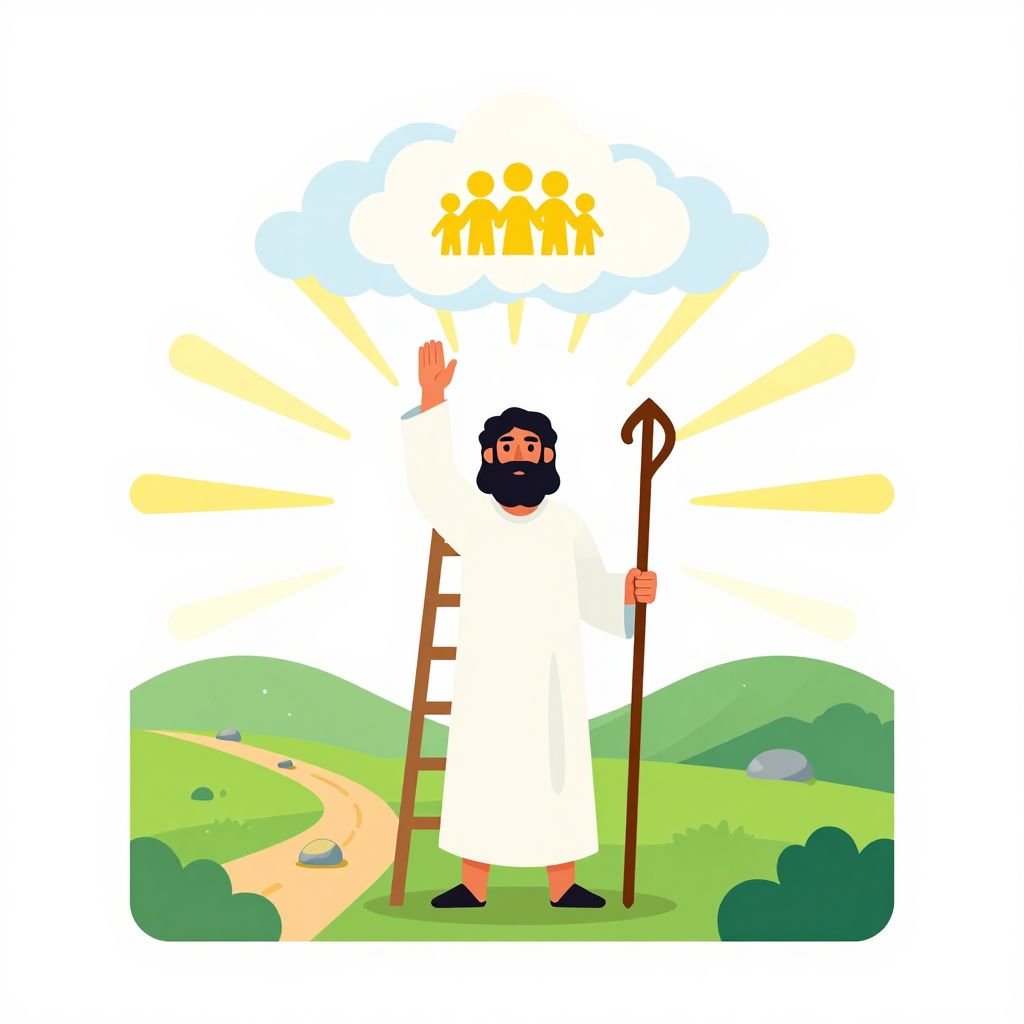
Jacob stands out as one of the most complicated and compelling characters in all of Scripture. He deceived his father, wrestled with God, raised a dysfunctional family, and yet became the father of the twelve tribes of Israel.
His story reveals something vital: God doesn’t wait for us to get our act together before He works through us. That truth alone makes Jacob’s life worth examining closely.
What Did Jacob Do in the Bible?
Jacob deceived his father Isaac to steal his brother Esau’s blessing, fled to his uncle Laban where he married Leah and Rachel, wrestled with God at Peniel and received the name Israel, and became the father of the twelve sons who formed the nation of Israel. His life demonstrates both human failure and God’s relentless faithfulness to His covenant promises.
Jacob’s Birth and the Struggle That Defined Him
Jacob entered the world grasping his twin brother Esau’s heel, and his name literally means “he grasps the heel” or “deceiver.” That’s not exactly the kind of name you’d pick from a baby book.
Genesis 25:26 tells us he came out holding onto Esau’s heel, and this physical detail foreshadowed the struggle that would mark his entire life. The conflict between these brothers started before birth and shaped the entire narrative of Jacob’s early years.
The Stolen Birthright
Jacob’s first recorded action as an adult shows his cunning nature in full display. He exploited his brother’s hunger to buy Esau’s birthright for a bowl of stew (Genesis 25:29-34).
This wasn’t a momentary lapse in judgment. Jacob saw an opportunity and seized it with calculated precision.
The birthright carried significant weight in ancient culture. It meant a double portion of the inheritance and the position of family leadership after the father’s death.
Jacob’s Deception of Isaac
The birthright transaction set the stage for an even darker moment. With his mother Rebekah’s help, Jacob disguised himself as Esau to trick his blind father Isaac into giving him the blessing meant for the firstborn son (Genesis 27).
He put goatskins on his arms and neck to mimic Esau’s hairy skin. He wore Esau’s clothes and brought his father a meal, lying directly to Isaac’s face when asked, “Are you really my son Esau?”
The Consequences of Deception
Esau’s rage forced Jacob to flee for his life. He left everything behind and ran to his uncle Laban in Haran, beginning a twenty-year exile.
This pattern shows up throughout Scripture: sin brings consequences that God doesn’t simply erase. Jacob got the blessing, but he lost his home, his family, and his sense of security.
Jacob’s Encounter With God at Bethel
While fleeing, Jacob stopped for the night and used a stone for a pillow. There, God met him in a dream and showed him a ladder reaching to heaven with angels ascending and descending on it (Genesis 28:10-22).
God spoke directly to Jacob, confirming the covenant He had made with Abraham and Isaac. He promised Jacob the land, countless descendants, and His presence wherever Jacob went.
Jacob’s Response
Jacob woke up and declared, “Surely the Lord is in this place, and I was not aware of it.” He set up the stone as a pillar, poured oil on it, and named the place Bethel, meaning “house of God.”
He also made a vow that if God would be with him and provide for him, then the Lord would be his God. Notice the conditional nature of that commitment.
Jacob’s Years With Laban
Jacob worked seven years to marry Rachel, the woman he loved, but Laban deceived him and gave him Leah instead (Genesis 29). The deceiver got deceived, and the irony couldn’t be thicker.
Jacob had to work another seven years for Rachel. During his time with Laban, he married both sisters, plus their maidservants Bilhah and Zilpah, and fathered eleven sons and one daughter.
The Birth of the Twelve Sons
Jacob’s twelve sons became the twelve tribes of Israel. Their births reveal a household filled with rivalry, favoritism, and pain:
- Leah’s sons: Reuben, Simeon, Levi, Judah, Issachar, and Zebulun
- Rachel’s sons: Joseph and Benjamin (born later)
- Bilhah’s sons: Dan and Naphtali
- Zilpah’s sons: Gad and Asher
Each birth narrative in Genesis 29-30 exposes the deep dysfunction in this family. The wives competed for Jacob’s affection through childbearing, and Jacob showed clear favoritism toward Rachel and her children.
Jacob’s Prosperity and Departure
Jacob used selective breeding techniques to increase his own flocks at Laban’s expense (Genesis 30:25-43). Some might call it shrewd business; others might call it manipulation.
After twenty years, God told Jacob to return to his homeland. He left secretly with his wives, children, and possessions while Laban was away shearing sheep.
Wrestling With God at Peniel
As Jacob approached the land of Canaan, he learned that Esau was coming to meet him with four hundred men. Terrified, he sent his family and possessions ahead and spent the night alone.
A man wrestled with Jacob until daybreak, and when the man couldn’t overpower him, He touched Jacob’s hip socket and wrenched it (Genesis 32:22-32). Jacob refused to let go until the man blessed him.
The Name Change
The man asked Jacob his name, and when Jacob answered, the man said, “Your name will no longer be Jacob, but Israel, because you have struggled with God and with humans and have overcome” (Genesis 32:28, NIV). Israel means “he struggles with God.”
Jacob realized he had seen God face to face, and he named the place Peniel, meaning “face of God.” He walked away with a limp, a permanent reminder of that encounter.
Have you ever wondered why God sometimes leaves us marked by our encounters with Him? Physical reminders keep spiritual truths from fading into vague memory.
Reconciliation With Esau
Jacob and Esau met the next day, and instead of violence, Esau ran to Jacob, embraced him, and wept (Genesis 33:4). Twenty years of fear dissolved in a moment of grace.
Jacob had sent elaborate gifts ahead to appease his brother, but Esau’s heart had already softened. The reconciliation shows God working in both brothers during their time apart.
Jacob’s Later Years and Family Tragedies
Jacob settled in Canaan, but his favoritism toward Joseph triggered jealousy among his other sons. His sons sold Joseph into slavery and deceived Jacob into believing his favorite son had been killed by a wild animal (Genesis 37).
The man who deceived his father now experienced deception from his own children. Jacob mourned Joseph for years, refusing to be comforted.
Other Family Disasters
Jacob’s daughter Dinah was violated by Shechem, and her brothers Simeon and Levi responded by massacring an entire town (Genesis 34). Jacob rebuked them, but primarily because their actions endangered the family, not because of the moral horror of what they’d done.
Rachel died giving birth to Benjamin, Jacob’s twelfth son. He buried her on the road to Bethlehem, and her death deepened his grief.
Jacob’s Move to Egypt
During a severe famine, Jacob discovered that Joseph was alive and serving as second-in-command in Egypt (Genesis 45-46). God spoke to Jacob at Beersheba, telling him not to be afraid to go down to Egypt.
Jacob moved his entire family to Egypt, where they settled in the region of Goshen. He was 130 years old when he arrived, and he lived there for seventeen more years.
Jacob’s Blessings Before Death
Before he died, Jacob blessed Joseph’s sons Ephraim and Manasseh, crossing his hands to give the greater blessing to the younger son (Genesis 48). Joseph tried to correct him, but Jacob knew exactly what he was doing.
He then gathered all twelve of his sons and pronounced prophetic blessings over each one (Genesis 49). These blessings revealed his knowledge of his sons’ characters and foretold the futures of their tribes.
He blessed Judah with the promise that the scepter would not depart from his tribe until the ruler came to whom it belongs. Christians recognize this as a messianic prophecy pointing to Jesus.
Jacob’s Death and Legacy
Jacob died in Egypt at age 147 and was embalmed according to Egyptian custom (Genesis 49:33). His sons carried his body back to Canaan and buried him in the cave of Machpelah with Abraham, Sarah, Isaac, Rebekah, and Leah.
His death marked the end of the patriarchal narratives in Genesis. The book that began with creation ends with a coffin in Egypt, setting the stage for the exodus story to come.
What Jacob’s Life Teaches Us
Jacob’s story refuses to let us reduce faith to simplistic formulas. He lied, manipulated, played favorites, and caused tremendous pain in his family.
Yet God chose him, blessed him, and worked through him to accomplish His purposes. That doesn’t excuse Jacob’s sins, but it does reveal something stunning about grace.
The New Testament references Jacob repeatedly. Jesus called Himself the ladder Jacob saw in his dream (John 1:51), connecting that ancient vision to His role as the bridge between heaven and earth.
Paul used Jacob and Esau to explain God’s sovereign choice in salvation (Romans 9:10-13). Hebrews 11:21 commends Jacob’s faith, mentioning that he worshiped as he leaned on his staff near the end of his life.
The God of Abraham, Isaac, and Jacob
God identified Himself throughout Scripture as “the God of Abraham, Isaac, and Jacob.” He attached His own name to a deceiver, a schemer, and a struggling father.
That choice tells us something vital about who God is. He doesn’t partner only with the polished and put-together.
He works with broken people, transforms them slowly, and remains faithful even when they stumble repeatedly. Jacob limped for the rest of his life, but he limped as Israel, the man who struggled with God and prevailed.
Applying Jacob’s Story Today
Jacob’s life offers several clear applications for believers today:
- God’s purposes aren’t derailed by our failures. He works in spite of us, not just through us.
- Deception always brings consequences, even when God chooses to use us anyway.
- Wrestling with God isn’t a sign of weak faith. Jacob’s greatest moment came when he refused to let go until he received a blessing.
- God transforms us gradually, not all at once. Jacob received his new name at Peniel, but the Bible still calls him Jacob in many passages afterward.
- Our family dysfunction doesn’t disqualify us from God’s service, though it does have real consequences for those around us.
Do you see yourself in Jacob’s struggles? Most honest believers do at some point.
Conclusion
Jacob deceived, manipulated, fled, worked, wrestled, reconciled, grieved, and blessed. His life reads like a complicated novel because it was a complicated life.
Yet through all of it, God remained present, faithful, and committed to His covenant. The twelve tribes of Israel came from Jacob’s messy household, and ultimately, Jesus Himself descended from the line of Judah, Jacob’s fourth son.
Jacob’s story refuses to let us believe that God only uses the perfect. Instead, it shows us a God who meets us in our messes, struggles with us through the night, marks us with His touch, and transforms us into people who can carry His name.
If you’re struggling today, wrestling with God, limping from past encounters, or carrying the weight of your own deceptions and failures, Jacob’s story speaks directly to you. God doesn’t write people off because they’re complicated. He writes His name into their stories and calls them His own.
Take time this week to read through Jacob’s full story in Genesis 25-50. Ask God to show you where He’s been faithful in your own complicated narrative, and trust that the God of Jacob is still in the business of transforming deceivers into people who bear His name.
If you’re interested in learning more about biblical figures and their significance, you might want to explore who was Jacob in greater depth. For those curious about specific practices mentioned in Scripture, discover what the Bible says regarding ancient covenant signs that marked God’s people throughout the Old Testament narrative.