
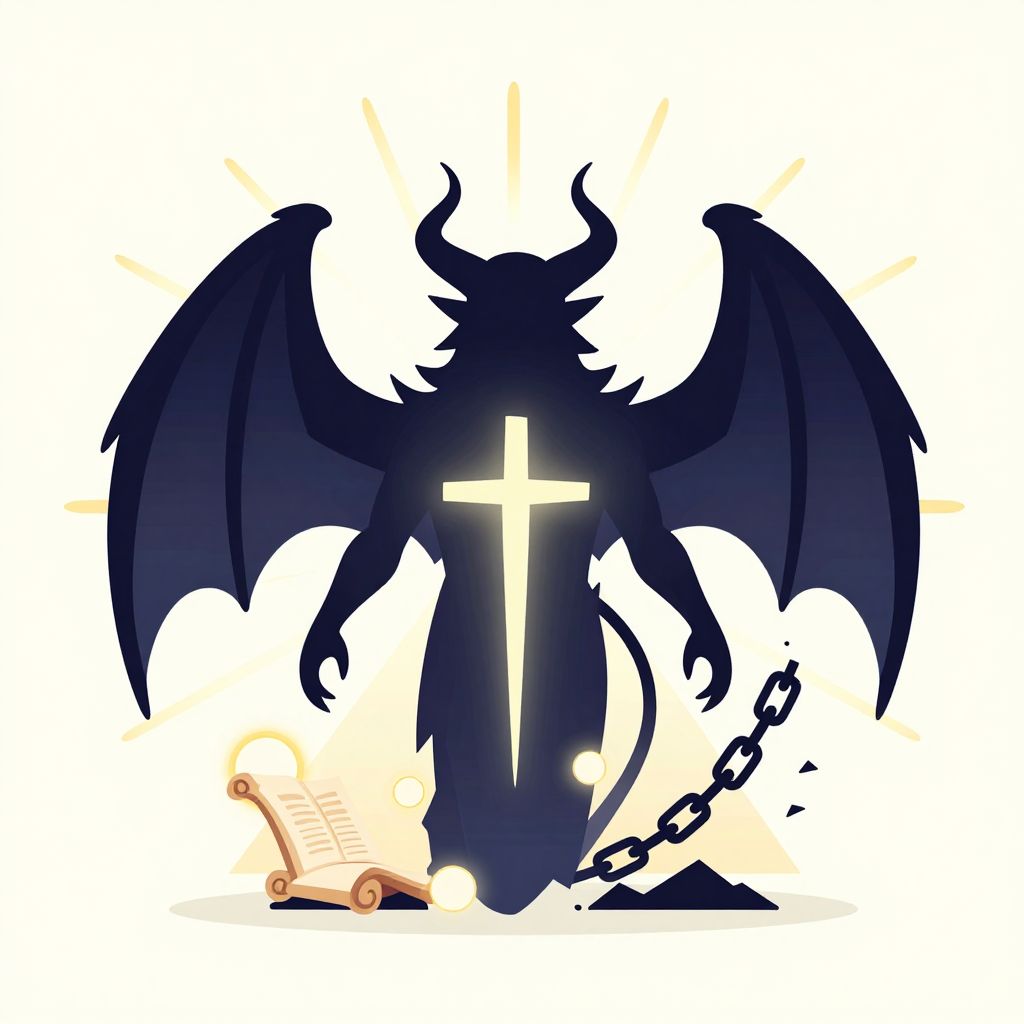
Demons show up throughout Scripture with a kind of terrifying consistency that makes it hard to ignore them. Yet many Christians struggle to know what they actually are, where they came from, and how much authority they really have over our lives.
The Bible doesn’t treat demons as folklore or metaphor. It presents them as real spiritual beings in active rebellion against God, and understanding what Scripture says about them equips us to live with both discernment and confidence in Christ’s authority.
What Are Demons in the Bible?
Demons are fallen angels who rebelled against God and now work to oppose His purposes and harm His creation. They operate under Satan’s leadership, seeking to deceive, oppress, and destroy, but they remain under God’s ultimate authority and were decisively defeated through Christ’s death and resurrection.
Fallen Angels, Not Independent Powers
Scripture reveals that demons are angels who joined Satan’s rebellion against God. Revelation 12:7-9 describes a war in heaven where the dragon and his angels were cast down to earth, identifying this group as the demonic forces we encounter throughout the Bible.
2 Peter 2:4 and Jude 6 both mention angels who sinned and are kept in chains of darkness until judgment. These passages confirm that demons are not a separate creation but corrupted versions of what God made good.
They retain some of their angelic abilities, including intelligence and power, but they have twisted these gifts toward evil. This explains why demons can perform counterfeit miracles and supernatural acts that might deceive people who don’t know better.
Organized Under Satan’s Authority
Demons don’t operate randomly. Ephesians 6:12 describes a structured hierarchy: rulers, authorities, powers of this dark world, and spiritual forces of evil in the heavenly realms.
Satan leads this dark kingdom, though he is not equal to God in any sense. He’s a created being with limits, and his forces answer to him while ultimately remaining subject to God’s sovereign control.
Jesus Himself referred to “Beelzebul, the prince of demons” in Matthew 12:24, acknowledging this demonic structure. The accusation was false, but Christ didn’t dispute that demons have a leader and an organized rebellion.
What Do Demons Actually Do?
They Deceive and Spread False Teaching
1 Timothy 4:1 warns that in later times some will abandon the faith by following deceiving spirits and things taught by demons. Demonic activity often begins in the mind, twisting truth and leading people away from God.
Demons promote lies about God’s character, Jesus’s identity, and the gospel itself. They work through false teachers, counterfeit religions, and spiritual practices that look enlightening but lead people into bondage.
This doesn’t mean every theological error is directly demonic, but persistent teaching that denies core biblical truths often has a spiritual source behind it. Demons thrive when people exchange God’s truth for lies.
They Oppress and Afflict People
The Gospels record numerous encounters between Jesus and demon-possessed individuals. These people suffered physically, mentally, and spiritually under demonic influence, unable to free themselves.
In Mark 5:1-20, the demon-possessed man lived among tombs, cut himself with stones, and had supernatural strength. The demons themselves begged Jesus not to torment them, revealing their fear of His authority.
Not every sickness or struggle is demonic. Job’s suffering, for instance, came from Satan but only by God’s permission and for purposes beyond demonic intention (sort of backfired when Job’s faith actually deepened).
They Influence Human Systems and Culture
Daniel 10:13 reveals that demonic “princes” opposed God’s angelic messengers and seemed connected to earthly nations. Spiritual warfare happens behind the scenes of human history and government.
Demons influence culture toward idolatry, immorality, and rebellion against God. 1 Corinthians 10:20 states plainly that pagan sacrifices are offered to demons, not to God, linking false worship directly to demonic powers.
This doesn’t mean Christians should see demons behind every cultural shift. But Scripture does call us to recognize that our struggle isn’t merely against human ideas but against spiritual forces promoting those ideas.
What Demons Cannot Do
They Cannot Act Outside God’s Sovereignty
Demons are powerful, but they are not sovereign. Job 1:12 shows Satan needing God’s permission even to harm Job, and the same limitation applies to all demonic forces.
God uses even demonic activity to accomplish His purposes. In 1 Kings 22:19-23, God permitted a lying spirit to deceive Ahab’s prophets, weaving even deception into His sovereign plan.
This truth should comfort believers deeply. No demon can touch you outside what God allows, and what He allows He will use for your good and His glory.
They Cannot Read Your Thoughts
Only God knows the heart. Demons may observe your behavior, hear your words, and make educated guesses, but they cannot read your mind the way God can.
1 Chronicles 28:9 and Jeremiah 17:10 attribute knowledge of the heart to God alone. This is why prayer remains a safe, private conversation between you and the Father, shielded from demonic interference.
Demons may tempt you based on patterns they’ve observed, but they’re working with limited information. They’re cunning, not omniscient.
They Cannot Overpower Christ’s Authority in a Believer
1 John 4:4 declares that the One who is in you is greater than the one who is in the world. If you belong to Christ, you have the Holy Spirit dwelling within you, and no demon can change that.
Colossians 2:15 says Jesus disarmed the powers and authorities, making a public spectacle of them and triumphing over them by the cross. The victory is already won.
Demons can harass, tempt, and attack, but they cannot possess a true believer. You are sealed by the Holy Spirit (Ephesians 1:13-14), and that seal cannot be broken by any created power.
How Should Christians Respond to Demonic Activity?
Stand Firm in Spiritual Armor
Ephesians 6:10-18 commands believers to put on the full armor of God. This isn’t a ritual or formula but a call to live grounded in truth, righteousness, the gospel, faith, salvation, and God’s Word.
Prayer forms the foundation of spiritual warfare. Paul urged believers to pray in the Spirit on all occasions with all kinds of prayers, staying alert and persistent.
Spiritual armor isn’t something you put on once. It’s the daily posture of a believer who knows the battle is real but trusts that God has already provided everything needed to stand.
Resist the Devil and He Will Flee
James 4:7 gives a simple, powerful command: submit to God, resist the devil, and he will flee from you. Resistance starts with submission, not with dramatic confrontations.
Demons respond to the authority of Christ, not to our personal power. When you resist in Jesus’s name, you’re invoking the authority of the One who has already conquered every demonic force.
This means you don’t need to fear demons or obsess over them. Acknowledge their reality, stand on Scripture, and trust that Christ’s authority in you is more than enough.
Don’t Give the Devil a Foothold
Ephesians 4:26-27 warns against letting anger give the devil a foothold. Unresolved sin, habitual rebellion, and spiritual compromise create openings for demonic influence.
This doesn’t mean one sin invites possession. It means ongoing, unrepentant patterns can give demonic forces room to work in areas of your life where you’ve pushed God out.
Walk in the light, confess sin quickly, and stay connected to the body of Christ. Isolation and secrecy are where demonic influence grows strongest.
Use Discernment, Not Paranoia
1 John 4:1 tells believers to test the spirits to see whether they are from God. Discernment is a gift of the Spirit that helps you recognize what is true and what is counterfeit.
Not every bad day is a demonic attack. Not every struggle is spiritual warfare in the dramatic sense.
Live alert, but don’t live afraid. The Christian life is not spent demon-hunting but God-honoring, and that focus keeps you grounded in truth rather than distracted by fear.
The Ultimate Defeat of Demons
Christ’s Victory on the Cross
Hebrews 2:14 explains that Jesus shared in our humanity so that by His death He might destroy him who holds the power of death, that is, the devil. The cross was the decisive blow.
Demons know their fate is sealed. James 2:19 says even demons believe in God and shudder, aware of the judgment coming but unable to repent or escape it.
Every exorcism Jesus performed was a preview of His total victory. He didn’t just cast out demons; He proclaimed the kingdom of God breaking into a world under siege.
The Final Judgment
Matthew 25:41 reveals that eternal fire was prepared for the devil and his angels. Demons will not escape, reform, or find mercy; their rebellion ends in eternal judgment.
Revelation 20:10 describes the devil being thrown into the lake of burning sulfur where he will be tormented day and night forever. The same fate awaits all demonic forces.
This is the future that is certain. Demons are defeated enemies operating on borrowed time, and every believer can live in the confidence of that coming reality.
Living With Confidence, Not Fear
Understanding what demons are doesn’t mean living in fear of them. It means living aware of the spiritual reality around you while resting in the greater reality of Christ’s authority.
You don’t need to see a demon behind every difficulty or assume spiritual attack in every trial. Walk closely with God, stay rooted in Scripture, and trust that the Spirit within you is greater than any force opposing you.
Demons are real, but they are not your focus. Christ is. And in Him, you have everything you need to stand firm, live free, and move forward in confidence.
If you’re exploring more about the spiritual realities Scripture addresses, you might find it helpful to read what the Bible says about witchcraft and how God calls His people to avoid practices that open doors to deception. You can also discover clarity on what the Bible says about ghosts and how Scripture speaks to questions about the afterlife and spiritual encounters. These topics help build a fuller biblical understanding of the unseen world and how to navigate it with wisdom and faith.