
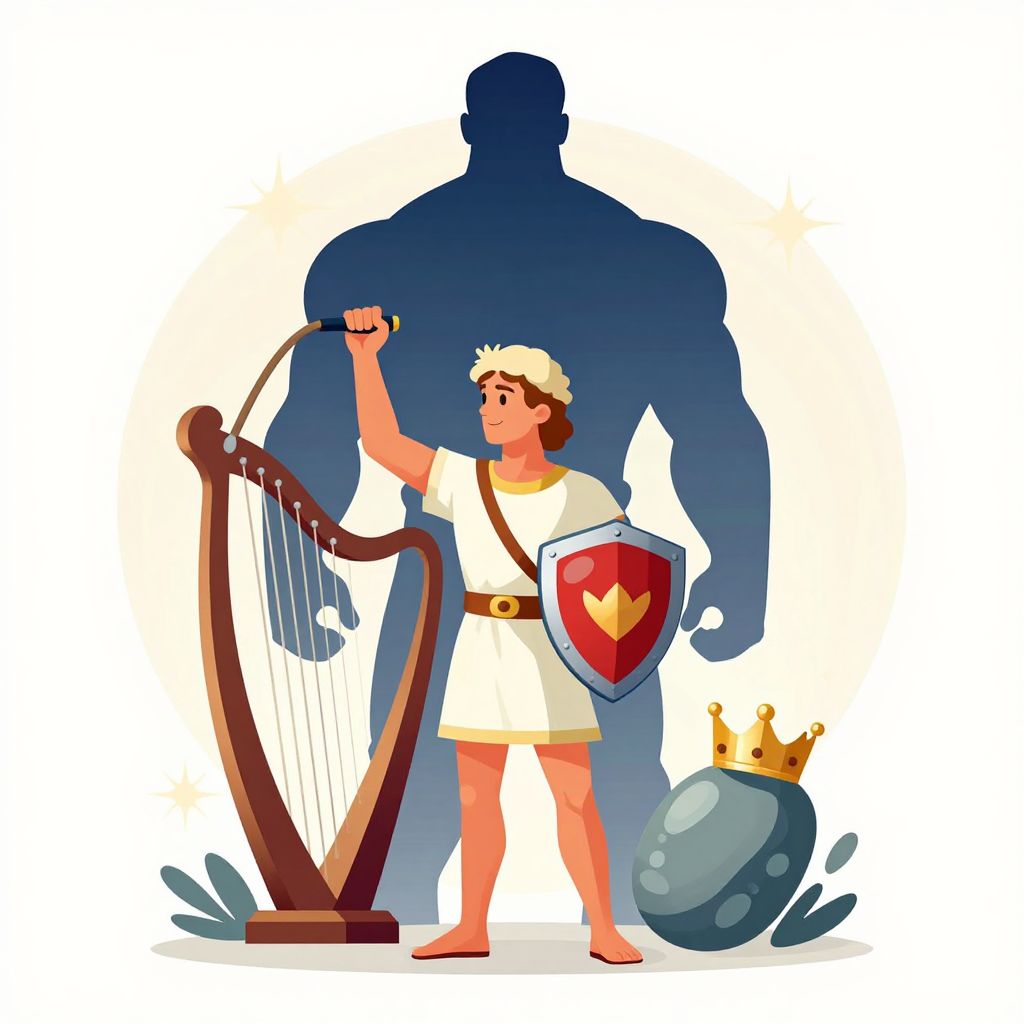
David stands as one of the most complex and consequential figures in all of Scripture. His life spanned shepherd boy, giant-slayer, king, psalmist, warrior, adulterer, and repentant sinner.
Understanding what David actually did in the Bible reveals not just ancient history, but the character of God who chooses flawed people for His purposes and remains faithful even when they fall.
What Did David Do in the Bible?
David served as Israel’s second and greatest king, defeated Goliath as a young shepherd, unified the nation, established Jerusalem as its capital, wrote many of the Psalms, and became the ancestor through whom the Messiah would come. His life reveals both remarkable faith and devastating sin, showing how God works through imperfect people who genuinely seek Him.
David’s Early Years as a Shepherd
David spent his youth tending his father’s sheep in Bethlehem, a job his older brothers considered beneath their notice. Yet this season prepared him for everything that followed.
He learned to protect the flock from lions and bears, killing them with his own hands according to 1 Samuel 17:34-37. These weren’t metaphorical battles but real confrontations that built both courage and dependence on God.
While his brothers went to war, David stayed with the sheep. Sometimes God’s most important preparation happens in the places that feel insignificant.
The Anointing by Samuel
God rejected all of David’s older, more impressive brothers and chose the youngest son to be Israel’s next king. The prophet Samuel anointed David while he was still a teenager, pouring oil over his head in a private ceremony that changed everything.
The Spirit of the Lord came upon David from that day forward, according to 1 Samuel 16:13. But the crown didn’t follow immediately.
David would wait approximately fifteen years between his anointing and his actual coronation. God’s promises don’t always arrive on our preferred schedule.
David and Goliath: Faith in Action
The story most people know about David involves a giant, a slingshot, and odds that made everyone else run for cover. David’s brothers had cowered before Goliath for forty days straight.
When David arrived at the battlefield to bring supplies, he heard Goliath’s taunts and asked a question that revealed his heart: “Who is this uncircumcised Philistine that he should defy the armies of the living God?” (1 Samuel 17:26, ESV).
Why David Volunteered
David didn’t see a giant problem. He saw a giant opportunity for God to display His power.
His confidence didn’t rest in his own ability but in the character of the God he served. He told King Saul about the lions and bears, not to brag, but to establish a track record of God’s faithfulness.
Faith isn’t pretending danger doesn’t exist. Faith recognizes danger and moves forward anyway because God is bigger.
The Battle Itself
David chose five smooth stones from the brook and faced Goliath with a sling, refusing Saul’s armor because he hadn’t tested it. He ran toward the battle line, not away from it.
One stone struck Goliath in the forehead, and the giant fell. David then used Goliath’s own sword to cut off his head, and the Philistine army fled in terror.
The victory didn’t just save Israel that day. It demonstrated a pattern David would follow throughout his life: attacking problems head-on with confidence in God’s power.
David’s Time Running from Saul
Success brought David fame, which ignited Saul’s jealousy. Women sang, “Saul has struck down his thousands, and David his ten thousands” (1 Samuel 18:7, ESV), and Saul’s heart turned murderous.
David spent years fleeing from cave to cave while Saul hunted him with an army. This wasn’t a brief inconvenience but a decade-long season of exile and danger.
Sparing Saul’s Life Twice
David had two clear opportunities to kill Saul and end his suffering. In the cave at En Gedi, David crept close enough to cut off a corner of Saul’s robe while the king relieved himself.
Later, David and his nephew Abishai snuck into Saul’s camp at night and stood over the sleeping king with a spear within reach. Both times, David refused to harm “the Lord’s anointed” (1 Samuel 24:6, ESV).
Respecting God’s timing matters more than ending our own discomfort. David understood that how we get to the throne determines what kind of king we’ll be.
Building a Band of Mighty Men
During his wilderness years, David attracted a following of about 600 men who were in debt, distressed, or discontented. Not exactly an impressive résumé list.
Yet these outcasts became David’s mighty warriors, men who performed legendary feats of courage and loyalty. Three of them once broke through enemy lines just to bring David water from his hometown well because he mentioned missing it.
God often builds His greatest works using people the world has written off. David’s hardship forged relationships that would sustain his kingdom for decades.
David as King of Israel
After Saul died in battle, David became king of Judah at age thirty. Seven years later, all the tribes of Israel united under his leadership, making him king over the entire nation.
David reigned for forty years total, transforming Israel from a loose confederation of tribes into a unified, powerful kingdom. His military campaigns expanded Israel’s borders to their greatest extent in history.
Conquering Jerusalem
David captured the fortress city of Jerusalem from the Jebusites, a feat considered impossible. He made it his capital, brilliantly choosing a city that belonged to no particular tribe and thus offended no one.
He brought the Ark of the Covenant to Jerusalem with celebration and dancing, making the city both the political and spiritual center of Israel. David danced before the Lord with all his might (2 Samuel 6:14, ESV), unconcerned about his dignity.
True worship doesn’t worry about looking foolish. It focuses entirely on honoring God.
The Davidic Covenant
David wanted to build God a temple, but God reversed the plan. Through the prophet Nathan, God promised to build David a house instead, a dynasty that would last forever.
God declared that David’s throne would be established forever (2 Samuel 7:16, ESV). This covenant pointed directly to Jesus Christ, the ultimate Son of David who would reign eternally.
David’s response wasn’t pride but humble worship. He sat before the Lord and asked, “Who am I, O Lord God?” (2 Samuel 7:18, ESV).
David’s Sin with Bathsheba
At the height of his power, David committed his most devastating sin. One evening he saw Bathsheba bathing and sent messengers to bring her to the palace.
She was married to Uriah, one of David’s own mighty men who was away at war. David slept with Bathsheba, and she became pregnant.
The Cover-Up That Made It Worse
David tried to cover his adultery by bringing Uriah home from battle, hoping he would sleep with his wife and assume the child was his. But Uriah refused to enjoy his home while his fellow soldiers camped in open fields.
David then orchestrated Uriah’s murder, sending him to the front lines with orders for the troops to withdraw and leave him exposed. Uriah died, and David married Bathsheba.
Sin rarely stops where we plan. One compromise leads to another, and the spiral accelerates faster than we expect.
Nathan’s Confrontation
God sent Nathan the prophet to confront David with a story about a rich man who stole a poor man’s only lamb. David burned with anger at the injustice until Nathan declared, “You are the man!” (2 Samuel 12:7, ESV).
David could have killed Nathan or imprisoned him. Instead, he immediately confessed: “I have sinned against the Lord” (2 Samuel 12:13, ESV).
Psalm 51 records David’s prayer of repentance, one of the most honest expressions of brokenness in all of Scripture. He didn’t make excuses or minimize his actions.
The Consequences
Nathan told David that God had forgiven him, but the sword would never depart from his house. The baby born from his adultery with Bathsheba died despite David’s desperate fasting and prayer.
His son Amnon would later rape his half-sister Tamar. Another son, Absalom, would murder Amnon and eventually lead a rebellion against David himself.
Forgiveness doesn’t always erase earthly consequences. David experienced both God’s mercy and the painful results of his choices for the rest of his life.
David as the Psalmist
David wrote at least 73 of the 150 Psalms, though some scholars attribute more to him. These songs reveal the inner life of a man who walked closely with God through triumph and disaster.
He penned Psalm 23 about the Good Shepherd, drawing from his own shepherd days. He wrote Psalm 18 celebrating God’s deliverance from his enemies.
Honest Wrestling with God
David’s psalms don’t hide his questions, fears, or anger. He asked God why He seemed distant, complained about his enemies, and admitted when his soul felt crushed.
Yet almost every psalm that begins in darkness moves toward praise. David taught us that honest prayer is better than polite pretending.
God wants our real hearts, not our religious performances. David gave Him both his worship and his wounds.
Prophetic Psalms
Some of David’s psalms pointed directly to the coming Messiah. Psalm 22 describes crucifixion in detail, written a thousand years before Rome invented that method of execution.
Psalm 110 speaks of a priest-king after the order of Melchizedek, fulfilled only in Jesus. David’s words transcended his own experience to reveal God’s future plans.
The Holy Spirit spoke through David’s pen to prepare generations for the Savior who would come from his lineage.
David’s Final Years
David’s later reign faced multiple rebellions and family tragedies. His son Absalom led a coup that temporarily drove David from Jerusalem, breaking the king’s heart.
When Absalom died in battle, David wept with a grief that shook his entire army: “O my son Absalom, my son, my son Absalom! Would I had died instead of you, O Absalom, my son, my son!” (2 Samuel 18:33, ESV).
Preparing for Solomon’s Reign
Though David couldn’t build the temple himself, he spent his final years gathering materials and making plans. He collected vast amounts of gold, silver, bronze, iron, and wood.
He organized the priests and Levites, established worship patterns, and gave detailed instructions to his son Solomon. David invested in what he would never personally see completed.
Faithfulness often means planting trees under whose shade we’ll never sit. David prepared the way for the next generation to build what God had shown him.
Final Instructions to Solomon
On his deathbed, David charged Solomon to walk in God’s ways and keep His commandments. He reminded his son that God’s promise to establish their dynasty depended on obedience.
David died at age seventy after reigning for forty years. 1 Kings 2:10 records simply that “David slept with his fathers and was buried in the city of David” (ESV).
His legacy wasn’t a perfect life but a heart that consistently returned to God, no matter how far he strayed.
David’s Lasting Impact
Scripture repeatedly calls David “a man after God’s own heart” (1 Samuel 13:14, Acts 13:22, ESV). This title doesn’t mean David never sinned but that he genuinely sought God above everything else.
Every king after David was measured against his standard. The prophets pointed to a future “son of David” who would restore Israel’s glory.
The Lineage of Jesus
Both Matthew and Luke trace Jesus’ genealogy through David, fulfilling the covenant promise that his throne would endure forever. Jesus was born in Bethlehem, the city of David.
Crowds called Jesus “Son of David” when He entered Jerusalem. The angel Gabriel told Mary that her son would sit on “the throne of his father David” (Luke 1:32, ESV).
David’s greatest legacy wasn’t his military victories or his psalms but the reality that God chose his family line to bring the Savior into the world. Has that truth ever struck you as personally as it should?
Lessons from David’s Life
David’s story teaches us that God doesn’t require perfection. He requires a heart willing to turn back to Him when we fail.
Consider these truths from David’s journey:
- God sees potential where others see insignificance (David was the youngest, overlooked son)
- Past faithfulness in small things prepares us for larger battles (lions and bears before Goliath)
- Waiting on God’s timing builds character that rushing destroys (the years between anointing and crown)
- Sin’s consequences remain even when forgiveness is complete (David’s family tragedies)
- Honest confession brings restoration (Psalm 51 and God’s continued use of David)
- Worship should be wholehearted, not dignified (dancing before the Ark)
David’s life proves that God can use broken people who refuse to stay broken. He doesn’t hide our failures but writes them into His story of redemption.
Walking in David’s Faith Today
David’s example calls us to approach God with the same raw honesty and passionate pursuit. His psalms give us language for our own prayers when words fail.
When you face giants, remember David didn’t rely on conventional weapons or other people’s armor. He used what God had already proven faithful in his hands.
When you fall into sin, remember David’s immediate confession rather than his initial cover-up. The difference between David and Saul was not that David sinned less but that he repented faster and more completely.
When you’re waiting for promises that seem delayed, remember David tending sheep after his anointing. God was preparing him even when nothing appeared to be happening.
When you worship, remember David dancing with abandon. Your dignity matters less than God’s glory.
The Heart That Defines David
David killed a giant, conquered a kingdom, wrote Scripture, and sinned terribly. But God remembered him for his heart, not his résumé.
A heart after God seeks Him in both celebration and crisis, confesses quickly, and refuses to let failure have the final word. David showed us what that looks like across decades of real, messy, glorious life.
You don’t need to be perfect to be used by God. You need to be willing to keep turning back to Him, keep seeking His face, and keep trusting His promises even when your circumstances scream otherwise.
David’s life answers the question of what God does with broken people who genuinely love Him. He forgives them, restores them, uses them, and writes their stories into the greatest story ever told.
If you’re interested in learning more about the kings of Israel and how their stories connect, explore who Solomon was and how he built on his father’s foundation. You might also want to understand who Saul was and why God replaced him with a shepherd boy. These connected stories reveal God’s consistent character across changing circumstances and flawed leaders.