
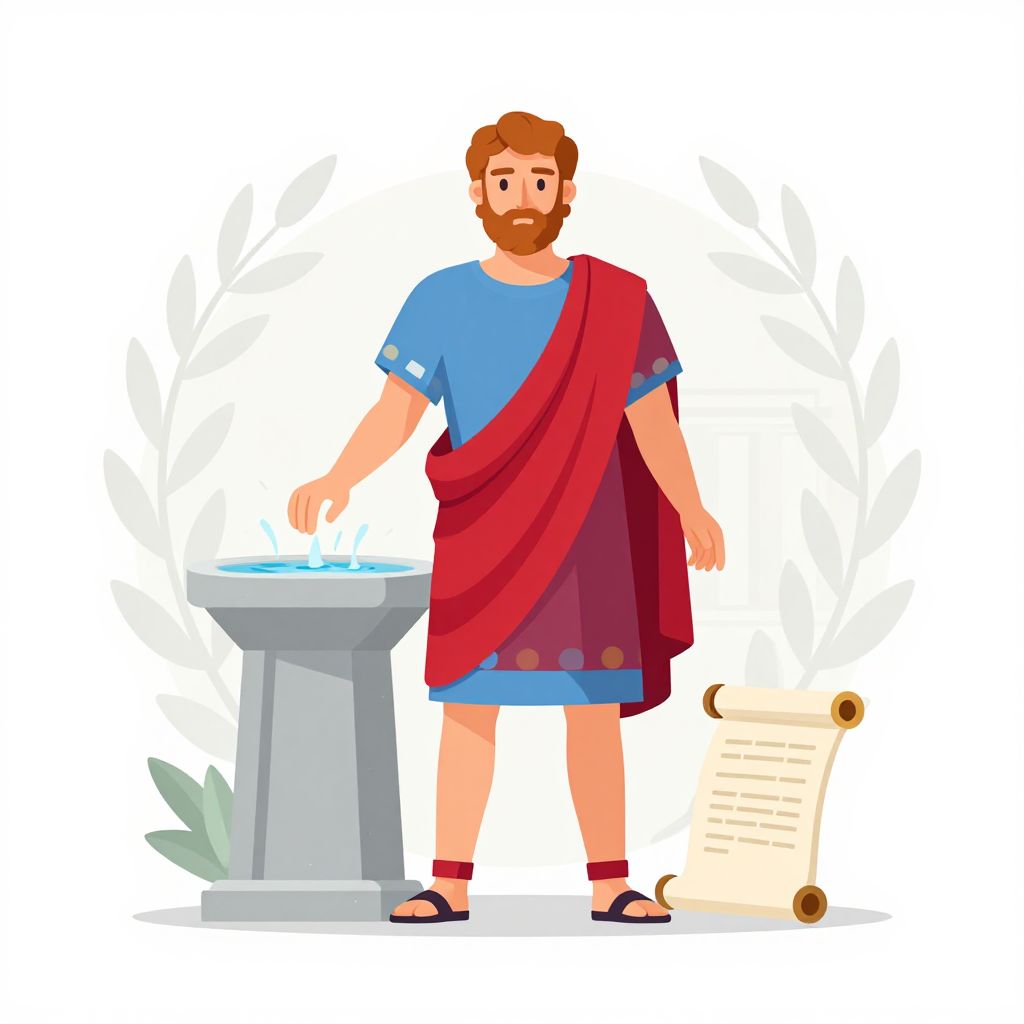
Pontius Pilate stands as one of the most haunting figures in the Gospel accounts, a man who held the power to release an innocent man but chose political safety instead. His name appears in the Apostles’ Creed, forever linking him to the crucifixion of Jesus Christ. Understanding who Pilate was helps us see the collision between earthly power and divine purpose, and it challenges us to examine where we might be washing our own hands of truth.
Every believer recites his name in ancient creeds, yet many know little about the man behind the title. Pilate’s story reveals how fear, compromise, and crowd-pleasing can lead even powerful people to participate in great evil.
Who Was Pontius Pilate in the Bible?
Pontius Pilate was the fifth Roman governor of Judea from approximately AD 26 to 36, appointed by Emperor Tiberius. He held absolute authority over life and death in the region, including the power to execute criminals. Scripture presents him as the official who authorized Jesus’ crucifixion despite finding no fault in Him, making Pilate a central figure in the Passion narrative and a sobering example of moral compromise.
Pilate’s Position and Authority
Pilate governed Judea as a prefect, wielding Rome’s full military and judicial power. His primary responsibilities included collecting taxes, maintaining order, and deciding capital punishment cases.
The Romans stationed him in Caesarea Maritima on the Mediterranean coast, but he traveled to Jerusalem during major Jewish festivals when crowds swelled and tensions ran high. This explains why Pilate was in Jerusalem during Passover when the religious leaders brought Jesus to him.
Historical records outside Scripture confirm Pilate’s existence and rule. An inscription discovered in 1961 at Caesarea names him as the prefect of Judea, and both Jewish historian Josephus and Roman historian Tacitus reference his governance.
His Reputation Before Meeting Jesus
Pilate had a well-earned reputation for brutality and insensitivity toward Jewish customs. Josephus records that he provoked outrage by bringing Roman military standards bearing Caesar’s image into Jerusalem, violating Jewish laws against graven images.
He also slaughtered Galilean worshipers in the temple, mixing their blood with their sacrifices, an atrocity Jesus referenced in Luke 13:1. Pilate funded a Jerusalem aqueduct with temple treasury money, then violently crushed the resulting protests.
The picture emerges of a harsh ruler who cared little for the people he governed. Yet when he faced Jesus, something shifted in him.
Pilate’s Encounter with Jesus
The religious leaders brought Jesus to Pilate early in the morning, desperate for Roman approval to execute Him. They couldn’t legally carry out capital punishment under Roman occupation, so they needed Pilate’s authorization.
The Initial Interrogation
John 18:38 records Pilate’s haunting question to Jesus: “What is truth?” This wasn’t casual philosophical musing but the response of a man confronted with Truth incarnate and unsure what to do with Him.
Pilate examined Jesus privately and found no basis for the charges against Him. He declared Jesus innocent not once but three times according to Luke’s Gospel, stating clearly, “I find no basis for a charge against this man” (Luke 23:4, NIV).
The Roman governor recognized something different about this prisoner. Jesus didn’t grovel, didn’t defend Himself desperately, and spoke with an authority that unsettled Pilate.
Political Maneuvering and Moral Cowardice
Pilate tried multiple tactics to avoid condemning Jesus while appeasing the increasingly hostile crowd. He sent Jesus to Herod Antipas when he learned Jesus was Galilean, hoping to shift responsibility to another jurisdiction.
When Herod returned Jesus, Pilate offered to release a prisoner as was customary during Passover. He presented the crowd with a choice between Jesus and Barabbas, a known murderer and insurrectionist, clearly expecting they would choose Jesus.
The crowd chose Barabbas. Pilate then had Jesus flogged, hoping this brutal punishment would satisfy the mob’s bloodlust without requiring crucifixion.
It didn’t work. The religious leaders and the crowd they stirred up demanded crucifixion, and Pilate felt the political ground shifting beneath him.
The Moment of Decision
The Jewish leaders played their trump card: “If you let this man go, you are no friend of Caesar. Anyone who claims to be a king opposes Caesar” (John 19:12, NIV). This threat struck at Pilate’s deepest fear.
Rome had no tolerance for governors who allowed rebellion or couldn’t maintain order. Pilate had already angered the Jews multiple times, and another complaint to Rome could end his career or worse.
Matthew 27:24 describes Pilate’s famous response: “When Pilate saw that he was getting nowhere, but that instead an uproar was starting, he took water and washed his hands in front of the crowd. ‘I am innocent of this man’s blood,’ he said. ‘It is your responsibility!'”
Pilate declared his own innocence while authorizing murder. He attempted to absolve himself symbolically while condemning Jesus legally, a contradiction that defines moral cowardice.
What Pilate’s Actions Reveal
Pilate’s behavior during Jesus’ trial exposes timeless spiritual truths about human nature, power, and the cost of compromise. His story isn’t ancient history but a mirror held up to every generation.
The Danger of Knowing Truth and Rejecting It
Pilate knew Jesus was innocent. He said so repeatedly and clearly.
He also sensed something remarkable about Jesus that set Him apart from other prisoners. John 19:8 tells us that when Pilate heard Jesus claimed to be the Son of God, “he was even more afraid.”
Pilate had enough evidence to do what was right, but he chose what was politically safe instead. Truth stood before him incarnate, and he asked, “What is truth?” then walked away from the answer.
This remains one of Scripture’s most sobering warnings. Intellectual acknowledgment of truth means nothing without obedient response.
The Illusion of Neutrality
Pilate wanted to remain neutral, to avoid choosing sides in what he saw as a Jewish religious dispute. He tried to wash his hands of the matter literally and figuratively.
But neutrality in the face of evil is itself a choice, and silence in the presence of injustice speaks volumes. Jesus said in Matthew 12:30, “Whoever is not with me is against me.”
Pilate discovered what many learn too late: you cannot wash your hands of responsibility when you hold the power to act. His handwashing became an empty gesture, a symbol of attempted self-justification that convinced no one, least of all himself.
The Cost of Fearing People More Than God
Pilate feared what the Jewish leaders might report to Rome. He feared losing his position, his power, and possibly his life.
Proverbs 29:25 warns, “Fear of man will prove to be a snare, but whoever trusts in the LORD is kept safe” (NIV). Pilate fell directly into this snare.
He had the authority to release Jesus, the evidence of Jesus’ innocence, and even an unsettling awareness that something supernatural was happening. But the roar of the crowd drowned out his conscience.
Pilate’s Role in God’s Sovereign Plan
Here’s where the story takes a turn that only God could orchestrate. Pilate’s moral failure served God’s redemptive purpose.
Unwitting Participation in Salvation
Acts 4:27-28 explains it clearly: “Indeed Herod and Pontius Pilate met together with the Gentiles and the people of Israel in this city to conspire against your holy servant Jesus, whom you anointed. They did what your power and will had decided beforehand should happen” (NIV).
Pilate chose evil, yet God used even that evil to accomplish the greatest good in human history. This doesn’t excuse Pilate’s sin, but it reveals God’s sovereignty over human choices.
The crucifixion wasn’t plan B when everything went wrong. It was plan A from before the foundation of the world, and even those who opposed Jesus fulfilled prophecy in their opposition.
The Title on the Cross
Pilate ordered a sign placed above Jesus on the cross: “Jesus of Nazareth, the King of the Jews,” written in Aramaic, Latin, and Greek. The chief priests objected, asking Pilate to change it to “This man claimed to be king of the Jews.”
John 19:22 records Pilate’s response: “What I have written, I have written.” In this small act of defiance, Pilate spoke more truth than he knew.
Jesus was and is the King, not just of the Jews but of all creation. Pilate’s inscription became an unwitting proclamation of the Gospel to everyone who passed by Golgotha that day.
What Happened to Pilate Afterward
Scripture doesn’t tell us Pilate’s ultimate fate, but historical sources provide clues. Josephus records that Pilate brutally suppressed a Samaritan religious gathering in AD 36, prompting complaints that led to his recall to Rome.
Tradition holds conflicting accounts of his end. Some say he was exiled and eventually committed suicide; others claim he converted to Christianity, though Scripture gives no support for this.
What we know for certain is that Pilate’s moment of decision before Jesus defined his legacy forever. Every time Christians worldwide recite the Apostles’ Creed and say Jesus “suffered under Pontius Pilate,” his name lives on connected to the crucifixion.
What Pilate’s Story Teaches Believers Today
Pilate’s account isn’t just history. It’s a warning and an invitation to examine our own responses to Jesus and truth.
The Question of Authority
Pilate asked Jesus, “Don’t you realize I have power either to free you or to crucify you?” Jesus replied, “You would have no power over me if it were not given to you from above” (John 19:10-11, NIV).
Every human authority exists only because God permits it. Pilate thought he controlled the situation, but he was actually playing a part in a drama God had written.
This truth comforts us when earthly powers seem to run unchecked. God remains sovereign even when authorities misuse their power.
The Danger of Compromise
Pilate compromised in stages. First, he flogged an innocent man to appease the crowd, then he handed Him over for crucifixion.
Compromise rarely happens all at once. It begins with small concessions to pressure, convenience, or fear, then grows until we find ourselves authorizing things we once would have condemned.
James 1:8 warns that “a double-minded man is unstable in all his ways.” Pilate tried to serve two masters: justice and political survival, truth and popularity.
He ended up serving neither well and lost his soul in the attempt.
The Call to Courage
Pilate’s failure challenges believers to respond differently when we face our own moments of decision. Will we stand with Jesus when it costs us something, or will we wash our hands and walk away?
Scripture calls us to a different path. Joshua 24:15 declares, “Choose for yourselves this day whom you will serve… But as for me and my household, we will serve the LORD” (NIV).
Pilate chose poorly. We can choose differently, but only if we decide before the crisis comes.
Reflection and Response
Pilate had everything: power, position, and the opportunity to do what was right. He also had all the evidence he needed to recognize Jesus’ innocence and uniqueness.
What he lacked was courage to act on what he knew. He valued his career more than justice, popularity more than truth, and temporary safety more than eternal significance.
We face similar choices, perhaps not as dramatically but just as spiritually significant. Do we speak up for Jesus when it might cost us friendships, promotions, or social standing?
Do we compromise biblical truth to fit in, or do we stand firm even when the crowd demands otherwise? Do we wash our hands of responsibility when God calls us to act?
Pilate’s story warns us that we cannot remain neutral about Jesus. Indecision is a decision, and silence is a statement.
The same Jesus who stood before Pilate stands before each of us with the same question He posed throughout His ministry: “Who do you say I am?” How we answer that question in our daily choices reveals what we truly believe.
Pilate washed his hands but couldn’t wash away his responsibility. We cannot delegate our spiritual decisions to others, blame circumstances for our choices, or claim neutrality when God calls us to commitment.
The good news is that unlike Pilate, we have the full revelation of who Jesus is and what He accomplished. We know the crucifixion wasn’t the end but the means to our salvation.
We know that three days later, Jesus rose from the grave, defeating the death sentence Pilate pronounced. The temporary authority Pilate wielded has long since turned to dust, but Jesus’ kingdom endures forever.
Ask God today for the courage Pilate lacked. Pray for the strength to choose truth over popularity, conviction over compromise, and Christ over crowd-approval. The same Spirit who raised Jesus from the dead lives in every believer, providing power to stand firm when everything around us demands we cave in.
Pilate’s legacy is a warning. Let yours be a testimony to the courage God provides when we trust Him more than we fear people.
If this look at Pilate’s role in Scripture has challenged you to examine other key figures in the Passion narrative, you might find it helpful to read about who Barabbas was, the prisoner released in Jesus’ place, or to explore the tragic story of Judas in the Bible and his betrayal of Christ. Each of these accounts reveals different facets of human nature and God’s sovereign plan working through broken people to accomplish perfect redemption.