
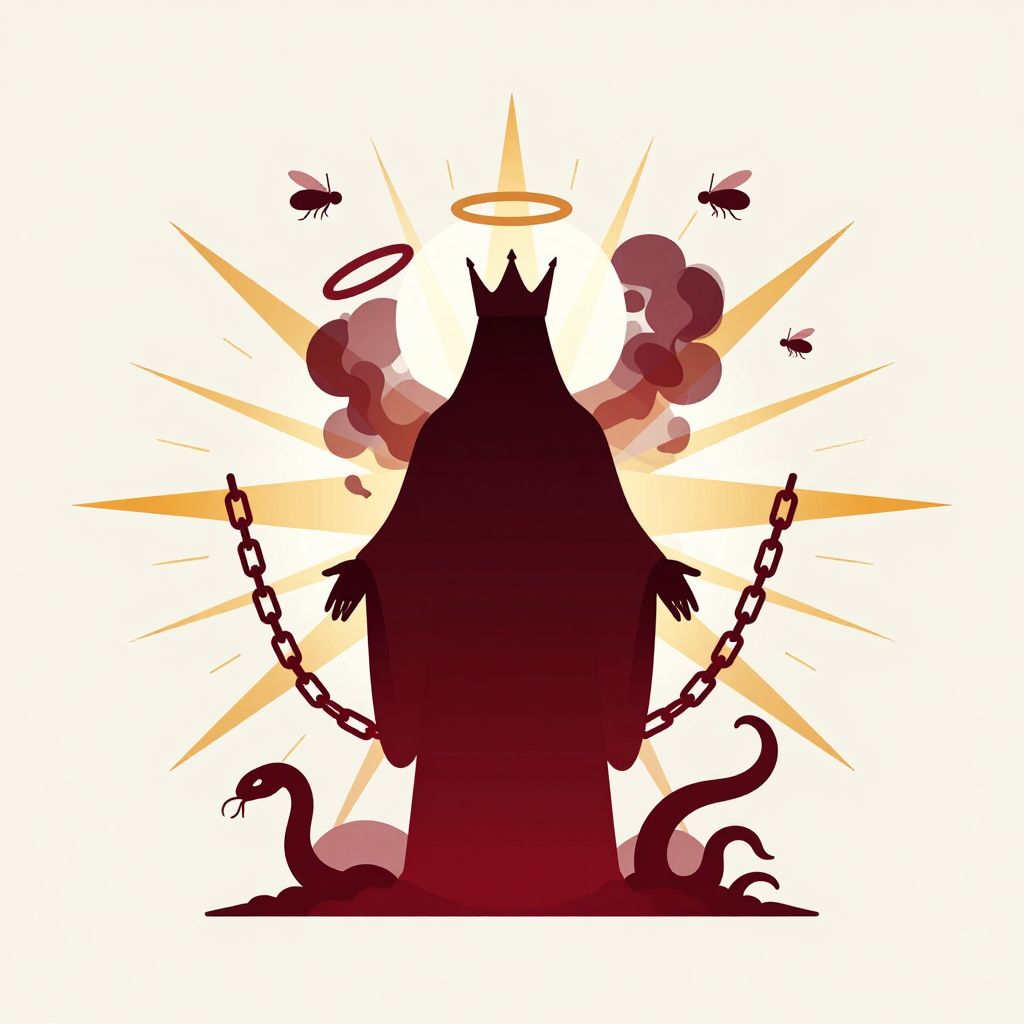
The name Beelzebub strikes fear into many hearts, yet confusion often follows close behind. This ancient title appears in both Old and New Testament passages, carrying weight that demands our careful attention.
Scripture reveals Beelzebub as both a pagan deity and a name associated with Satan himself. Understanding this figure helps us grasp the spiritual battles that surround us and the authority Christ holds over all dark powers.
Who Is Beelzebub in the Bible?
Beelzebub represents a powerful demonic entity, originally worshipped as “Baal-zebub,” the god of Ekron, and later identified in the New Testament as a name for Satan or a chief demon under his authority. Christ’s encounters with accusations involving Beelzebub reveal both the reality of spiritual warfare and His supreme authority over all evil forces.
The Old Testament Origins
Baal-zebub first appears in 2 Kings 1:2 when King Ahaziah of Israel sends messengers to inquire of this pagan god after suffering an injury. The name literally means “lord of the flies,” though some scholars suggest it may be a deliberate Hebrew corruption of “Baal-zebul,” meaning “lord of the dwelling” or “exalted lord.”
This consultation with a foreign deity represented a direct violation of God’s commands and showed Ahaziah’s spiritual rebellion. God responded by sending Elijah to intercept the messengers with a pointed question: “Is it because there is no God in Israel that you are going off to consult Baal-zebub, the god of Ekron?” (2 Kings 1:3, NIV).
From Pagan God to Demonic Power
By the time of Christ’s ministry, Jewish understanding had evolved to identify Beelzebub with demonic forces. The Philistine deity had become associated with the prince of demons in Jewish thought.
This transformation reflects how pagan gods were often understood by Jewish people as demonic deceptions rather than mere false idols. Paul later confirms this perspective in 1 Corinthians 10:20, explaining that pagan sacrifices are offered “to demons, not to God.”
Beelzebub in Christ’s Ministry
The Pharisees’ Accusation
The most significant New Testament references to Beelzebub occur when religious leaders accuse Jesus of casting out demons by Beelzebub’s power. Matthew 12:24 records their claim: “It is only by Beelzebub, the prince of demons, that this fellow drives out demons.”
This accusation represented more than skepticism about Christ’s methods. The Pharisees faced an undeniable reality—demons fled at Jesus’ command—but refused to acknowledge His divine authority.
Christ’s Logical Response
Jesus responds with devastating logic that exposes the absurdity of their claim. He asks in Matthew 12:25-26: “How can Satan drive out Satan? If a kingdom is divided against itself, that kingdom cannot stand.”
This response reveals crucial truths about spiritual warfare. Evil forces work together toward destruction, not against each other toward liberation.
The Unforgivable Sin Warning
Christ’s encounter with the Beelzebub accusation leads to His sobering warning about blasphemy against the Holy Spirit. Matthew 12:31-32 declares that this sin “will not be forgiven, either in this age or in the age to come.”
The context suggests this unforgivable sin involves persistently attributing the Holy Spirit’s obvious work to Satan. The Pharisees witnessed clear evidence of God’s power yet deliberately credited it to evil forces.
What Beelzebub Reveals About Spiritual Reality
The Hierarchy of Evil
The title “prince of demons” suggests an organized hierarchy within Satan’s kingdom. Ephesians 6:12 confirms this structure, describing “spiritual forces of evil in the heavenly realms” with various ranks and authorities.
Understanding this organization helps believers recognize that spiritual warfare involves coordinated opposition to God’s purposes. We face not random evil but strategic resistance to righteousness.
The Deception of False Religion
Beelzebub’s transformation from worshipped deity to recognized demon illustrates how Satan disguises himself as an object of worship. 2 Corinthians 11:14 warns that “Satan himself masquerades as an angel of light.”
This deception continues today through religious systems that promote spirituality while denying Christ’s unique authority. How carefully do we test spiritual claims against Scripture’s truth?
Christ’s Authority Over Beelzebub
Demonstrated Power
Every demon-possessed person Jesus encountered found complete freedom through His command. Mark 1:27 records the crowd’s amazement: “He gives orders to impure spirits and they obey him!”
Christ never struggled with demonic resistance or required elaborate rituals for deliverance. His simple word carried absolute authority over all spiritual forces.
Delegated Authority
Jesus extends this authority to His followers for ministry purposes. Luke 10:17 records the disciples’ joy: “Lord, even the demons submit to us in your name.”
This delegated authority comes through relationship with Christ, not personal power or special techniques. The demons recognize and respond to Jesus’ name when used by His genuine followers.
Practical Implications for Believers
Recognition of Spiritual Opposition
Beelzebub’s biblical presence reminds us that spiritual forces actively oppose God’s work. 1 Peter 5:8 warns that “your enemy the devil prowls around like a roaring lion looking for someone to devour.”
This recognition should produce vigilance, not fear. We face a defeated enemy whose ultimate fate is sealed, though his current activity remains real.
Dependence on Christ’s Authority
The Pharisees’ error teaches us to recognize and acknowledge God’s work rather than explain it away. When we witness clear answers to prayer or genuine spiritual transformation, we honor God by crediting Him appropriately.
Do you sometimes find yourself minimizing God’s obvious intervention in your life? Gratitude and testimony glorify Him while strengthening your faith.
Confidence in Victory
Colossians 2:15 declares that Christ “disarmed the powers and authorities” and “made a public spectacle of them, triumphing over them by the cross.” Beelzebub and all demonic forces serve a defeated master.
This victory belongs to every believer through faith in Christ. We engage spiritual battles from a position of triumph, not hoping for victory but applying victory already won.
Standing Firm Against Deception
Beelzebub’s biblical appearances consistently involve deception and false attribution of power. Today’s believers face similar challenges when culture explains away God’s work or credits human effort for divine intervention.
The armor of God described in Ephesians 6:10-18 equips us for these battles. Truth, righteousness, peace, faith, salvation, and God’s Word provide complete protection against spiritual deception.
Remember that our struggle “is not against flesh and blood” but against spiritual forces that operate through human systems and thinking. Beelzebub represents opposition that requires spiritual weapons and divine strength.
Stand confident in Christ’s authority, alert to spiritual deception, and grateful for the victory He has already secured. The prince of demons serves the King of kings, whether he acknowledges it or not.
Looking to deepen your biblical knowledge and strengthen your faith foundation? Explore more essential topics through our comprehensive guide on what does the bible say about life’s most pressing questions, and discover the rich spiritual heritage found throughout where is the bible belt and its enduring Christian influence.