
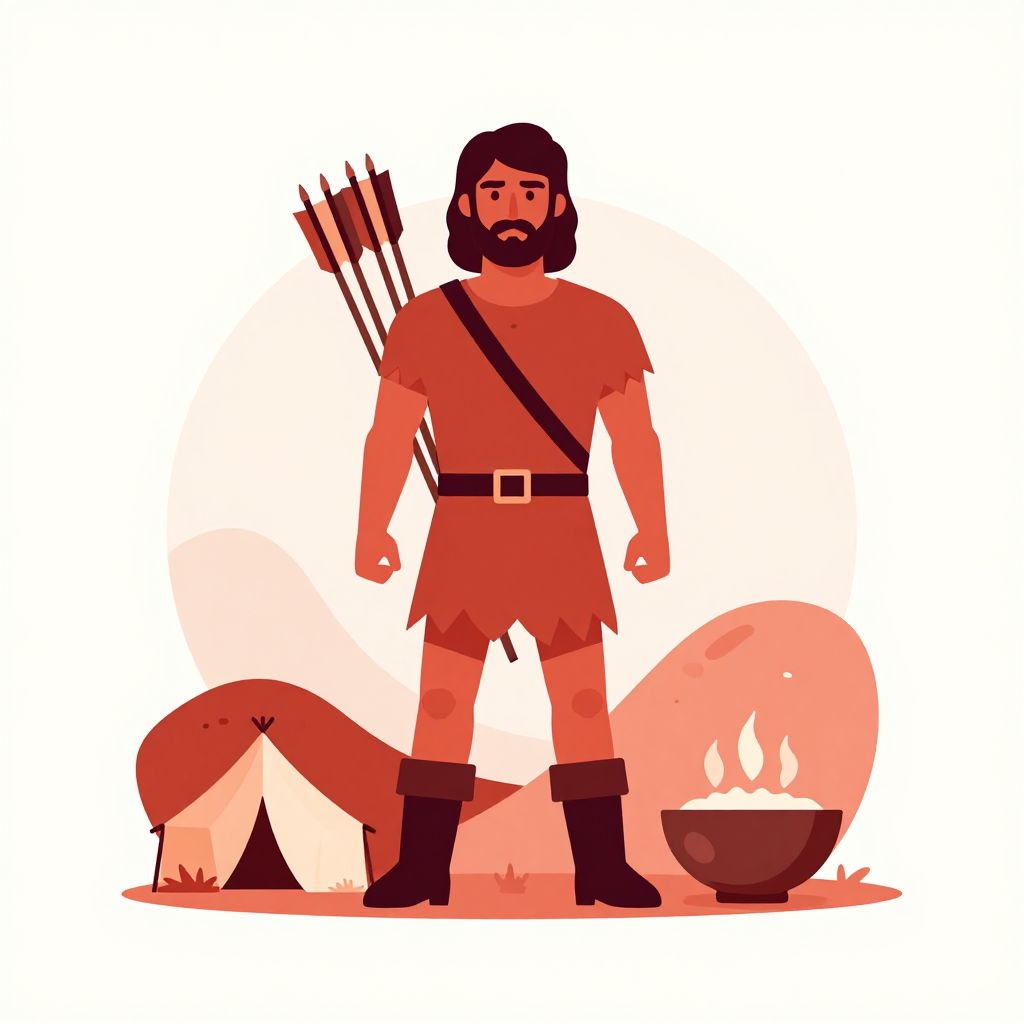
When you think of biblical brothers, Cain and Abel might come to mind first, but Esau’s story cuts deeper into questions we all face about choices, consequences, and God’s sovereignty. His life reads like a warning and a comfort wrapped into one compelling narrative.
Esau stands as one of Scripture’s most complex figures—a man whose single decision cost him everything, yet whose story reveals profound truths about God’s grace, human nature, and the weight of our choices. Understanding Esau means understanding something vital about ourselves and the God who works through even our worst moments.
Who Was Esau in the Bible?
Esau was the eldest son of Isaac and Rebekah, twin brother to Jacob, and the man who sold his birthright for a bowl of stew. He represents the tragic figure who traded eternal significance for temporary satisfaction, becoming a cautionary tale about priorities and the consequences of impulsive decisions.
Esau’s Birth and Early Identity
Esau entered the world first, emerging red and hairy from his mother’s womb. His very name means “hairy,” while his brother Jacob followed, grasping Esau’s heel—a prophetic picture of their lifelong struggle.
Genesis 25:25 (ESV) describes him: “The first came out red, all his body like a hairy cloak, so they called his name Esau.” God marked him from birth as distinct, setting the stage for a story that would echo through generations.
Esau grew into everything his appearance suggested—a skilled hunter, an outdoorsman, a man’s man who thrived in the wilderness. Isaac loved him for the wild game he brought home, creating a family dynamic that would prove destructive.
The Hunter and the Homebody
Scripture presents Esau and Jacob as opposites in almost every way. Where Jacob stayed close to the tents, Esau roamed the open country with his bow.
Genesis 25:27 (ESV) captures this perfectly: “When the boys grew up, Esau was a skillful hunter, a man of the field, while Jacob was a quiet man, dwelling in tents.” This wasn’t just about personality—it revealed their hearts’ directions.
Esau lived for the immediate, the tangible, the here-and-now pleasure that hunting and outdoor life provided. He found his identity in what he could do rather than in what God had promised his family.
What Did Esau Do Wrong?
Esau’s failures weren’t just about one bad decision on one hungry day. His choices revealed a heart pattern that prioritized the temporary over the eternal, the physical over the spiritual.
Selling His Birthright
The most famous moment in Esau’s life happened when he returned from hunting, exhausted and famished. Jacob had prepared a stew that smelled incredible, and Esau wanted it immediately.
Genesis 25:32-33 (ESV) records Esau’s tragic words: “I am about to die; of what use is a birthright to me?” So he swore to him and sold his birthright to Jacob. In that moment, Esau revealed what he truly valued.
The birthright meant more than money or property. It carried spiritual leadership of the family, connection to God’s covenant promises, and responsibility for future generations.
Esau looked at eternal significance and said, “What good does that do me right now?” He chose immediate gratification over lasting inheritance, and Scripture makes clear this was no small mistake.
Despising What God Valued
Genesis 25:34 (ESV) delivers one of Scripture’s most sobering assessments: “Thus Esau despised his birthright.” The Hebrew word for “despised” means to treat as worthless, to hold in contempt.
Esau didn’t just make a poor decision in a moment of weakness. He fundamentally misunderstood what mattered, treating God’s promises like they were worth less than a meal.
This pattern continued throughout his life. Genesis 26:34-35 (ESV) tells us “When Esau was forty years old, he took Judith the daughter of Beeri the Hittite to be his wife, and Basemath the daughter of Elon the Hittite, and they made life bitter for Isaac and Rebekah.”
Esau married foreign women who didn’t share his family’s faith, creating household tension and showing continued disregard for the spiritual values his parents held dear. His choices consistently prioritized his own desires over God’s design.
Missing the Point of Consequences
When Isaac prepared to give his final blessing, Esau planned to receive it as the older son. But Rebekah and Jacob conspired to steal that blessing through deception.
Esau’s response reveals his heart. He wept bitterly and begged his father, “Have you not reserved a blessing for me?” (Genesis 27:36 ESV). He wanted the blessing’s benefits without understanding he’d already forfeited the right to receive it.
This wasn’t just about Jacob’s trickery. Esau had already sold his birthright, already shown contempt for spiritual things, already demonstrated his priorities through his marriages and lifestyle.
What Does Esau Represent Spiritually?
Esau’s story transcends ancient family drama. He represents a spiritual condition that threatens every believer—the temptation to trade eternal treasure for temporary pleasure.
The Danger of Spiritual Carelessness
Hebrews 12:16-17 (ESV) uses Esau as a warning: “See to it that no one is sexually immoral or unholy like Esau, who sold his birthright for a single meal. For you know that afterward, when he desired to inherit the blessing, he was rejected, for he found no chance to repent, though he sought it with tears.”
The writer of Hebrews calls Esau “profane”—a word that means treating sacred things as common. Esau’s fundamental problem wasn’t hunger; it was a heart that couldn’t distinguish between what mattered eternally and what satisfied immediately.
This warning pierces through centuries to challenge modern believers. How often do we trade spiritual priorities for immediate gratification?
Do we skip prayer for extra sleep, choose entertainment over Scripture, or compromise convictions for social acceptance? Esau’s story forces us to examine what we actually value when pressure mounts.
The Tragedy of Irreversible Consequences
Scripture presents Esau’s story with haunting finality. When he sought to reclaim his blessing, “he found no chance to repent, though he sought it with tears” (Hebrews 12:17 ESV).
This doesn’t mean God cannot forgive any sin. It means some earthly consequences cannot be undone, some opportunities cannot be recovered, and some moments of decision carry weight we cannot foresee.
Esau could not undo his sale of the birthright. The blessing belonged to Jacob now, and tears could not reverse what legal transaction and divine sovereignty had established.
His story reminds us that choices have consequences that extend beyond our ability to fix them. We cannot presume upon God’s grace or assume we can always repair what we break through careless decisions.
A Mirror for Self-Examination
Before we feel too superior to Esau, his story should drive us to honest self-reflection. What “birthright” are we tempted to sell for temporary satisfaction?
Consider these modern parallels:
• Trading family relationships for career advancement
• Compromising integrity for financial gain
• Choosing comfort over calling
• Pursuing pleasure instead of purpose
• Selecting convenience rather than character
Esau’s impulsiveness lives in every human heart. We all face moments when immediate desire wars against eternal significance, when what we can see and touch seems more real than what God promises.
How Does God’s Sovereignty Work Through Esau’s Story?
Esau’s choices were real and carried real consequences, but God’s purposes prevailed through even this family’s dysfunction. His story reveals how divine sovereignty works through human decisions without excusing them.
God’s Prophetic Word Fulfilled
Before the twins were born, God told Rebekah, “Two nations are in your womb, and two peoples from within you shall be divided; the one shall be stronger than the other, the older shall serve the younger” (Genesis 25:23 ESV). God’s plan preceded their choices.
This doesn’t make Esau a puppet or excuse his decisions. God knew Esau’s character and chose Jacob despite Jacob’s own moral failings.
The doctrine of election runs through Esau’s story, but it never diminishes human responsibility. Esau chose his path freely, and God held him accountable for those choices while accomplishing His covenant purposes through Jacob’s line.
Grace in the Midst of Judgment
Even in discipline, God showed Esau mercy. Genesis 27:39-40 (ESV) records Isaac’s blessing for Esau: “Behold, away from the fatness of the earth shall your dwelling be, and away from the dew of heaven on high. By your sword you shall live, and you shall serve your brother; but when you grow restless you shall break his yoke from your neck.”
Esau would not inherit the covenant promises, but he would not be destroyed. His descendants would become the nation of Edom, and eventually they would gain independence from Israel’s dominance.
God’s judgment included hope. Even those who forfeit spiritual inheritance can experience temporal blessings and eventual freedom from immediate consequences.
What Can We Learn From Esau Today?
Esau’s life offers both warning and instruction for contemporary believers. His failures teach us to guard our hearts against spiritual carelessness and to value what God values.
The Importance of Long-term Thinking
Esau lived for the moment, and that perspective cost him everything. Believers must cultivate eternal perspective, learning to weigh temporary pleasure against lasting significance.
This requires intentional spiritual discipline. We must regularly remind ourselves of God’s promises, invest time in Scripture and prayer, and surround ourselves with people who share eternal values.
When faced with decisions, ask yourself: “How will this choice look in ten years? What will it mean for my relationship with God and my spiritual inheritance?”
Guarding Against Spiritual Drift
Esau didn’t wake up one day and decide to despise his birthright. He drifted away from spiritual values through small compromises and misplaced priorities.
His story warns us to pay attention to our spiritual trajectory. Are we growing closer to God or slowly moving away? Are we valuing eternal things more or finding them increasingly irrelevant to daily life?
Spiritual drift happens gradually, making it dangerous and difficult to recognize. Regular self-examination, accountability relationships, and commitment to spiritual disciplines help us stay on course.
Understanding God’s Heart for the Lost
God’s dealings with Esau reveal both justice and mercy. He honored Esau’s choices while providing grace even in consequence.
This should shape how we view people who seem to reject spiritual things. We cannot know their hearts’ final condition, and we must continue showing them God’s love while respecting their freedom to choose.
Some people, like Esau, may trade spiritual inheritance for temporary satisfaction. Our job is not to judge but to demonstrate what they’re missing through our own commitment to eternal values.
Esau’s Legacy and God’s Faithfulness
Esau’s story doesn’t end with his tears over the lost blessing. His later life shows both the lasting consequences of his choices and God’s continued provision even outside the covenant line.
Reconciliation and Maturity
Years later, when Jacob returned from Laban’s household, he feared meeting Esau again. But Genesis 33:4 (ESV) records a beautiful moment: “But Esau ran to meet him and embraced him and fell on his neck and kissed him, and they wept.”
Esau had matured beyond his initial anger and murderous intent. He had prospered in Seir, built his own household, and apparently found peace with his life’s direction.
This reconciliation shows that even those who forfeit spiritual inheritance can experience emotional healing and family restoration. God’s grace extends beyond covenant boundaries.
The Continuation of God’s Plan
Through Jacob’s line came the twelve tribes of Israel, and ultimately, Jesus Christ. God’s covenant promises continued despite family dysfunction, human scheming, and moral failure.
Esau’s story reminds us that God’s purposes are not dependent on human perfection. He works through broken families, flawed individuals, and complicated circumstances to accomplish His redemptive plan.
While Esau forfeited his place in that direct line, his story serves a crucial purpose in Scripture—warning us about spiritual carelessness while demonstrating God’s sovereignty over human choices.
Esau’s life stands as both warning and encouragement. His failures caution us against trading eternal inheritance for temporary satisfaction, but his story also reveals a God who remains faithful even when we falter. As you continue exploring these foundational biblical narratives, consider learning about Jacob’s journey and discovering more about what Scripture teaches regarding God’s character and our response to His calling.